

On Loving a Soul Dog: A Somatic Therapist's Take on Grief and Pet Loss
Some losses are immediately legible to the world. People know what to do with them. They bring food, they send cards, they ask how you are for months afterward.
Losing a soul dog is not always that kind of loss. The grief can be enormous, total, and disorienting in ways that catch people off guard, including people who knew the relationship well. It rewrites the essence of ordinary days. It changes what mornings feel like. It removes a presence so woven into the fabric of your life that its absence is felt everywhere, including in the body.
This post is about that kind of loss: what it actually is, why it lands so hard, and what it looks like to move through it, including when you are still in the middle of it or in the anticipatory phase.
What makes a soul dog different
Not every dog is a soul dog, and most people who have had one know the difference. A soul dog is not just a beloved pet. It is a specific, irreplaceable relationship that often spans a defining period of your life. They were there through the apartment you moved into alone, the relationship that fell apart, the job you quit, the version of yourself you were still figuring out. They knew your routines before you had language for them. They were present for things no one else witnessed.
For some people, a soul dog is also something more specific than that. They may be the first relationship in which you felt consistently met. Not loved conditionally, not loved when you performed correctly or needed less or showed up in the right way, but simply met. Present with, without agenda. Dogs don't evaluate you. They don't withdraw when you disappoint them or attach conditions to the relationship continuing. For people who grew up in environments where love felt unpredictable or had to be earned, a soul dog may have been the first experience of what consistent, attuned presence actually feels like. The first taste of what secure attachment is.
That is not a small thing developmentally. And it means that losing a soul dog can be, for some people, losing the relationship that first taught them what safety felt like. That is a different kind of loss than losing a beloved companion. It is worth naming it as such.
This is the quality that makes the loss of a soul dog so singular. They held a kind of continuity with you. They were a witness to your history. When they are gone, that witness is gone too, and with it a thread that connected you to earlier versions of yourself.
That is not a small thing. It is, in fact, a profound thing.
When you know the loss is coming
Many people begin grieving their soul dog long before there is any reason to. Not when the diagnosis comes, not when the aging becomes visible, but years earlier, while the dog is completely healthy and absolutely fine, sitting next to you on the couch while you quietly fall apart about the fact that someday, eventually, they will not be here. If this has happened to you, you are not alone and you are not being dramatic. You are just paying attention to what you have.
This early grief is the nervous system already registering how significant this relationship is. The dread is proportionate to the attachment, even when it looks irrational from the outside.
When the loss does become more imminent, whether through a diagnosis, a decline, or simply the weight of watching them age, the grief takes on a different quality. Anticipatory grief is real grief. It is not borrowing trouble. It is the body and heart responding to what is already true: that something irreplaceable is moving toward an ending. You may find yourself grieving in the middle of ordinary moments, a walk, a meal, a nap on the couch together, because you are aware in a new way that these moments are finite. That awareness is not morbid. It is love paying attention.
This phase can also carry a particular kind of exhaustion. You are present for them, managing their needs, making hard decisions, while also holding your own grief privately because the loss hasn't happened yet and the world doesn't always know how to hold anticipatory loss with care. If you are in this season right now, it counts. What you are carrying is real, and you don't have to wait until after to acknowledge how heavy it is.
Why this grief is so hard to carry
Grief after losing a soul dog is complicated by several layers that are worth naming directly.
The first is disenfranchised grief: grief that occurs when the loss isn't recognized or validated by the people around you or by society more broadly. Disenfranchised grief doesn't hurt less than other grief. It often hurts more, because you're carrying the loss while simultaneously managing other people's discomfort with how much it affects you. You might find yourself minimizing what you feel to make others more comfortable, or feeling ashamed of your own grief because the world keeps implying it should be smaller.
The second is the particular nature of the attachment itself. Dogs are co-regulators. This is not a metaphor. They are attuned to us in ways that are physiologically real: tracking our breath, our posture, our nervous system state. For many people, a soul dog was a daily source of physical grounding. The weight of them settling next to you on the couch. The routine of the morning walk. The way their presence in a room changed the quality of the room. When that is gone, the body notices. The absence is felt as much as it is thought.
This is part of why the grief can feel so total. You are not just missing someone you loved. Your body is missing a relationship it relied on.
What grief in the body actually looks like
Grief is not only an emotional experience. It lives in the body, and it tends to show up in ways people don't always recognize as grief.
You might notice a heaviness in your chest that doesn't lift. A flatness in your energy that sleep doesn't touch. An impulse to reach for them that your hand completes before your mind catches up. You walk to their spot. You listen for them at the door. The body holds the shape of the relationship long after the relationship has ended.
This is normal. It is not a sign that something is wrong with you or that you are grieving too much. It is what the body does when it loses someone it was organized around.
Some people also find that losing a soul dog opens something older. A grief that was waiting. This can happen when the loss is layered, when the dog carried you through an earlier loss, or when the relationship held something that had nowhere else to live. If you find yourself grieving more than just your dog, that makes sense too. The body doesn't grieve in categories.
What actually helps
There is no timeline for this kind of grief, and there is no version of it you are supposed to be doing better by now.
What tends to help is not rushing it. Letting the routines that included them change slowly rather than erasing them all at once. Naming what you lost with specificity, to yourself and to people who can hold it: not just "my dog" but the particular dog, the particular relationship, the particular way your days were shaped around each other.
It also helps to let the body be part of the grieving. This might look like continuing the morning walk even when it hurts, because movement has always been part of how you processed things. It might look like sitting with the grief instead of managing it, letting yourself feel the weight of it without immediately reaching for distraction. It might look like noticing where the loss lives in your body and staying with that for a moment rather than moving away from it.
Grief rituals can also hold something that ordinary days cannot. Creating an altar with their photo, their collar, something that was theirs. Have a physical space where you can continue making offerings of your love that spans beyond the physical plane. Lighting a candle each evening. These are not acts of clinging. They are containers for love that has nowhere else to go. They make the grief visible to yourself when the world has moved on, and they honor the relationship as something that continues to matter even after the loss. Many people do these things instinctively and feel sheepish about it, as though it signals an inability to let go. It doesn't. It signals that you know what you had.
Grief asks something of us. It asks us to stay present with loss rather than outlast it. That is hard to do in a culture that would prefer grief to be brief and private. It is even harder to do when the loss is one the culture doesn't fully recognize.
You don't have to justify this
If you lost your soul dog and you are still not okay, you are not failing at grief. You are in it.
The relationship was real. The loss is real. The way it lives in your body is real. None of that requires an explanation or an apology, and none of it has an expiration date.
Some losses change the shape of things for a long time. This is one of them. Letting yourself know that is not giving in to grief. It is telling the truth about what the relationship meant.
If you want support
Grief after losing a soul dog is real grief, and it deserves real support. Whether you are in active grief after a loss or carrying the weight of anticipatory grief while your dog is still here, you don't have to hold it alone. Working with a therapist who understands loss from a body-level perspective can help. Not to move through grief faster, but to move through it in a way that doesn't leave you more alone with it.
If you're in California and looking for that kind of support, I'd be glad to talk. You can learn more about how I work with grief at compassionatetides.com, or reach out directly to schedule a consultation.
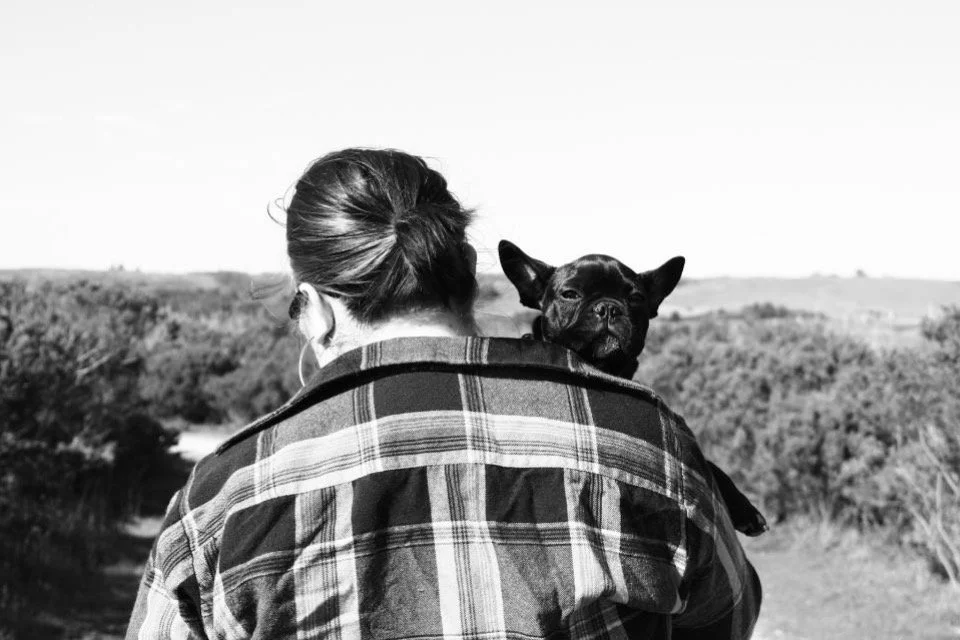
This post is dedicated to Burt, my soul dog for nearly twelve years. I wrote this for everyone who has loved a dog the way I loved him.
Sage Swiatek is a licensed clinical social worker and somatic therapist based in California. She specializes in grief, trauma, OCD, and anxiety, and works with adults via telehealth across the state.
